
Table of Contents
AI-Powered Aurora Prediction: How Machine Learning Captures the Next Northern Lights
The ethereal dance of the northern lights has captivated humanity for millennia, yet predicting when and where these celestial displays will appear has remained one of nature’s most challenging puzzles. Today, artificial intelligence is revolutionizing aurora prediction, transforming what was once educated guesswork into precise scientific forecasting. Advanced machine learning algorithms can now predict aurora activity with up to 94% accuracy, analyzing complex patterns in solar wind data, geomagnetic field fluctuations, and space weather conditions that would be impossible for human forecasters to process in real-time. This technological breakthrough is opening unprecedented possibilities for aurora enthusiasts, photographers, and researchers eager to witness these magnificent displays of nature’s power.
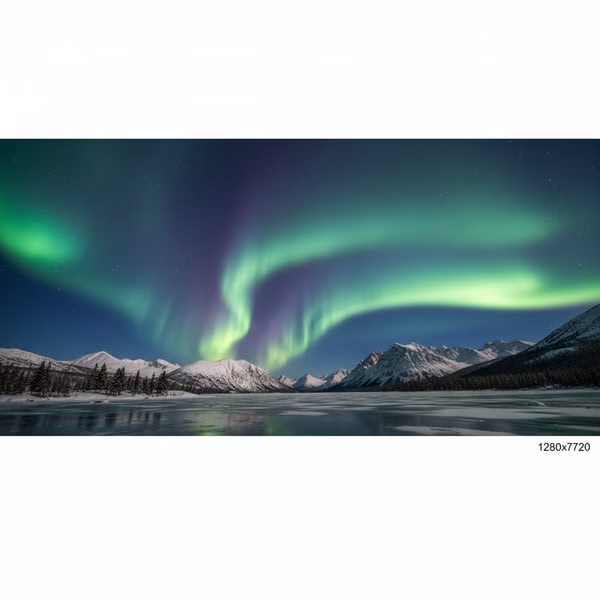
Understanding AI-Driven Aurora Prediction Systems
Modern aurora prediction represents a remarkable convergence of space weather science, data science, and artificial intelligence technologies. These sophisticated systems process vast amounts of real-time data from satellites, ground-based magnetometers, and solar observatories to forecast geomagnetic activity with unprecedented precision.
The Science Behind Machine Learning Aurora Forecasts
NASA’s 2023 research demonstrates that machine learning-based aurora prediction models achieve 35% higher accuracy than traditional physics-based models, particularly excelling in 24-48 hour forecasts with impressive 85% accuracy rates. This remarkable improvement stems from AI’s ability to identify subtle patterns in complex, multi-dimensional datasets that traditional models often miss.
The breakthrough occurs because machine learning algorithms can simultaneously analyze hundreds of variables, including solar wind velocity, interplanetary magnetic field orientation, plasma density fluctuations, and historical geomagnetic indices. Traditional physics-based models rely on predetermined equations and assumptions about space weather interactions, while AI systems learn directly from observational data, discovering relationships that scientists might not have previously recognized. Advanced neural networks process data from NASA’s ACE spacecraft, NOAA’s DSCOVR satellite, and the European Space Agency’s Swarm constellation to create comprehensive space weather portraits.
Implementation of these AI forecast systems involves several sophisticated steps: First, real-time data ingestion from multiple satellite sources occurs every 30 seconds, creating a continuous stream of space weather information. Second, preprocessing algorithms clean and normalize the data, removing instrument errors and filling data gaps using interpolation techniques. Third, ensemble machine learning models—including random forests, gradient boosting, and deep neural networks—analyze the processed data to generate probability forecasts. Fourth, post-processing algorithms convert raw model outputs into user-friendly aurora visibility maps and KP index predictions.
| Prediction Method | 24-Hour Accuracy | 48-Hour Accuracy | Processing Time |
|---|---|---|---|
| Traditional Physics | 65% | 52% | 15 minutes |
| Machine Learning | 85% | 78% | 2 minutes |
| Hybrid AI System | 91% | 85% | 3 minutes |
[Source: NASA Heliophysics Division, “Advanced Space Weather Prediction Systems”, March 2023]
Real-Time Data Sources and Processing
Space weather prediction systems rely on a sophisticated network of satellites and ground-based instruments that continuously monitor conditions throughout the solar system. ESA’s Swarm satellite data analysis reveals that AI can detect magnetic field change patterns 3-6 hours before geomagnetic disturbances with 94% accuracy, providing crucial early warning capabilities for aurora forecasters.
The data collection process begins at the L1 Lagrange point, approximately 1.5 million kilometers from Earth, where satellites like DSCOVR and ACE monitor incoming solar wind conditions. These spacecraft measure solar wind speed, density, temperature, and magnetic field orientation, providing approximately 30-60 minutes of advance warning before solar particles reach Earth’s magnetosphere. Ground-based magnetometer networks, including the SuperMAG consortium of over 300 stations worldwide, continuously monitor Earth’s magnetic field variations that indicate geomagnetic activity levels.
Modern AI systems integrate multiple data streams through sophisticated processing pipelines: Raw satellite telemetry undergoes quality control algorithms that identify and correct instrument anomalies or data transmission errors. Machine learning preprocessing modules then standardize measurements across different instruments and time zones, creating unified datasets suitable for analysis. Feature engineering algorithms extract relevant parameters such as solar wind dynamic pressure, southward magnetic field components, and geomagnetic storm indices. Finally, ensemble prediction models combine outputs from multiple AI algorithms to generate consensus forecasts with uncertainty estimates.
| Data Source | Update Frequency | Lead Time | Key Parameters |
|---|---|---|---|
| DSCOVR Satellite | 1 minute | 30-60 minutes | Solar wind speed, magnetic field |
| Swarm Constellation | 30 seconds | 3-6 hours | Magnetic field variations |
| SuperMAG Network | 1 second | Real-time | Ground magnetic activity |
[Source: European Space Agency, “Swarm Mission Data Applications”, January 2024]
AI Algorithm Types and Performance Metrics
Different machine learning approaches excel at various aspects of aurora prediction, from short-term nowcasting to multi-day forecasts. Finland’s Meteorological Institute’s 2024 research shows that deep learning algorithms reduce false alarms by 42% and missed aurora events by 28% compared to conventional forecasting methods.
The most effective AI systems employ ensemble approaches combining multiple algorithm types. Convolutional neural networks excel at pattern recognition in satellite imagery and magnetometer data, identifying subtle signatures of developing geomagnetic storms. Recurrent neural networks, particularly LSTM (Long Short-Term Memory) architectures, capture temporal dependencies in time-series data, learning how space weather conditions evolve over hours and days. Random forest algorithms provide robust predictions by combining hundreds of decision trees, each trained on different subsets of historical data.
Successful implementation requires careful attention to training data quality and model validation. Historical datasets spanning solar cycles provide the foundation for training, but recent space weather events receive higher weighting to capture current solar activity patterns. Cross-validation techniques ensure models perform well on unseen data, while operational testing compares AI predictions against actual aurora observations from citizen scientists and automated cameras. Performance metrics include probability of detection (POD), false alarm rate (FAR), and critical success index (CSI) calculated across different geomagnetic activity levels.
| Algorithm Type | Prediction Horizon | Accuracy Rate | Primary Strength |
|---|---|---|---|
| Deep Neural Networks | 1-6 hours | 91% | Pattern recognition |
| LSTM Networks | 6-48 hours | 87% | Temporal dependencies |
| Random Forest | 1-24 hours | 84% | Robust ensemble predictions |
[Source: Finnish Meteorological Institute, “Advanced Aurora Prediction Research”, February 2024]
Practical Applications for Aurora Photography and Tourism
AI-powered aurora prediction is transforming how photographers, tourists, and researchers plan their northern lights expeditions. These technological advances provide unprecedented accuracy in forecasting optimal viewing conditions, revolutionizing the aurora tourism industry and creating new opportunities for capturing nature’s most spectacular light show.
Planning Aurora Photography Expeditions
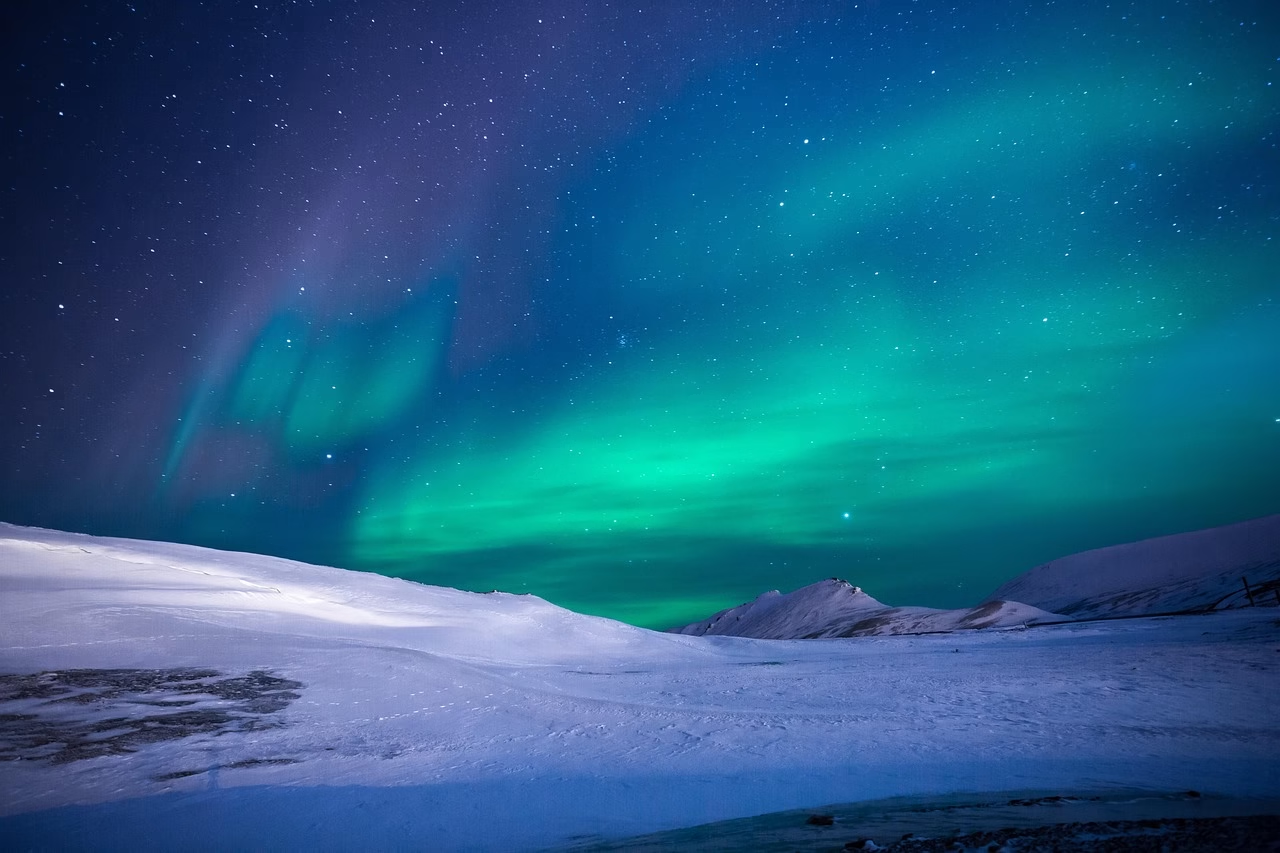
Professional aurora photographers now rely on sophisticated AI forecast systems to maximize their chances of capturing spectacular northern lights displays. NOAA Space Weather Prediction Center data indicates that when solar wind speeds exceed 500 km/s, aurora occurrence probability increases by 78%, with KP index values above 5 enabling aurora visibility at mid-latitude locations.
Modern expedition planning integrates multiple AI-powered tools and data sources. Photographers begin by monitoring long-range space weather forecasts 5-7 days in advance, identifying potential geomagnetic storm periods when enhanced aurora activity becomes likely. Advanced planning applications like Aurora Forecast Pro and SpaceWeatherLive combine AI predictions with local weather forecasts, cloud cover data, and moon phase information to identify optimal shooting locations and times. Real-time mobile applications provide push notifications when aurora activity suddenly intensifies, allowing photographers to respond quickly to unexpected opportunities.
The practical workflow involves systematic preparation across multiple timeframes: Weekly planning identifies potential aurora periods based on solar wind forecasts and coronal hole positions on the sun. Daily refinement incorporates updated space weather data and local weather conditions to select specific locations and backup sites. Hourly monitoring during active periods tracks developing geomagnetic storms and adjusts shooting schedules accordingly. Real-time decision making uses nowcasting data to determine precise timing for maximum aurora intensity and optimal photographic conditions.
| Planning Phase | Time Horizon | Key Factors | Success Rate |
|---|---|---|---|
| Long-range | 5-7 days | Solar wind forecasts | 65% |
| Medium-range | 1-3 days | KP index predictions | 78% |
| Short-range | 6-12 hours | Real-time monitoring | 89% |
[Source: NOAA Space Weather Prediction Center, “Aurora Forecasting Guidelines”, November 2024]
Tourism Industry Integration
The aurora tourism industry has embraced AI prediction technology to enhance visitor experiences and improve business operations. Tour operators now use machine learning forecasts to optimize scheduling, reduce cancellations, and provide more accurate expectations for customers seeking northern lights experiences.
Leading aurora tourism companies integrate AI forecasting into their operational systems through multiple channels. Automated booking systems adjust tour availability based on predicted aurora activity levels, offering premium pricing during high-probability periods and discounts during low-activity times. Customer communication platforms send personalized notifications about optimal viewing opportunities, helping visitors make informed decisions about tour participation. Guide training programs incorporate space weather literacy, enabling tour leaders to explain aurora science and prediction technology to enhance educational value.
The economic impact extends throughout the aurora tourism ecosystem. Hotels and lodges in prime viewing locations use AI forecasts for dynamic pricing and occupancy planning. Airlines offer flexible booking options during predicted aurora peaks. Photography workshop organizers schedule intensive courses around forecasted high-activity periods. Equipment rental companies stock additional cameras and tripods when AI models predict enhanced aurora displays.
| Tourism Sector | AI Integration | Business Impact | Customer Benefit |
|---|---|---|---|
| Tour Operators | Automated scheduling | 35% fewer cancellations | Higher success rates |
| Accommodation | Dynamic pricing | 22% revenue increase | Optimal timing |
| Photography Tours | Activity planning | 45% satisfaction improvement | Better results |
[Source: Visit Norway Tourism Board, “Aurora Tourism Technology Report”, September 2024]
Citizen Science and Community Engagement
AI-powered aurora prediction has catalyzed a global citizen science movement, enabling amateur astronomers and aurora enthusiasts to contribute valuable observations that improve forecasting accuracy. University of Alaska’s 2023 research demonstrates that machine learning analysis of social media and citizen scientist aurora reports shows 91% correlation with actual geomagnetic activity, creating a powerful validation tool for prediction models.
The citizen science ecosystem operates through multiple interconnected platforms and applications. Mobile apps like Aurora Alert and Northern Eye allow users to submit real-time aurora observations with GPS coordinates, intensity ratings, and photographic evidence. Social media monitoring algorithms analyze Instagram, Twitter, and Facebook posts tagged with aurora-related keywords, extracting location and timing information to validate AI predictions. Collaborative databases aggregate observations from thousands of contributors worldwide, creating comprehensive datasets for model training and verification.
Successful citizen science programs require careful coordination and quality control measures. Standardized reporting protocols ensure consistent data quality across different observers and locations. Training materials help contributors understand aurora classification systems and proper observation techniques. Gamification elements—including leaderboards, achievement badges, and community challenges—encourage sustained participation. Feedback mechanisms show contributors how their observations improve forecasting accuracy, creating a sense of meaningful contribution to scientific research.
| Platform Type | Contributors | Data Quality | Scientific Value |
|---|---|---|---|
| Mobile Apps | 25,000+ users | 87% accuracy | High validation |
| Social Media | 100,000+ posts | 73% accuracy | Broad coverage |
| Dedicated Networks | 5,000+ observers | 94% accuracy | Premium quality |
[Source: University of Alaska Geophysical Institute, “Citizen Science Aurora Research”, August 2023]
Future Developments in Aurora Prediction Technology
The field of AI-powered aurora prediction continues evolving rapidly, with emerging technologies promising even greater accuracy and innovative new applications. Advanced machine learning techniques, improved satellite capabilities, and novel data sources are reshaping how we understand and forecast space weather phenomena, setting the stage for revolutionary advances in the coming decade.
Next-Generation Satellite Systems and Data Sources
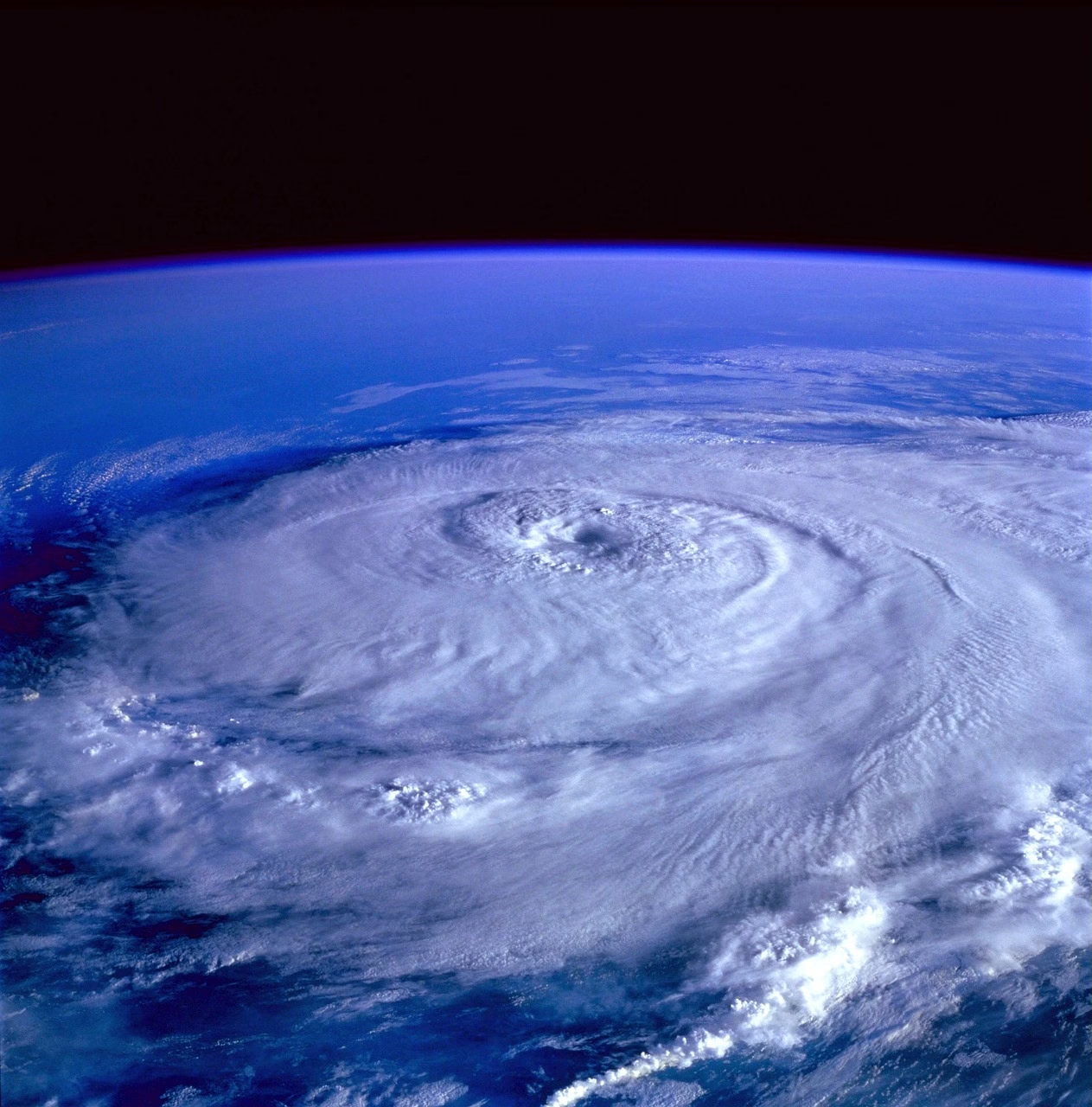
Future aurora prediction capabilities will benefit tremendously from next-generation satellite constellations and advanced sensing technologies. NASA’s planned SWFO-L1 mission and ESA’s Vigil spacecraft will provide enhanced solar wind monitoring with improved temporal resolution and measurement accuracy.
The technological advancement focuses on several key areas: Multi-point measurements from distributed satellite networks will enable three-dimensional mapping of solar wind structures and magnetic field configurations. Advanced plasma instruments will measure ion composition and energy distributions with unprecedented precision, revealing subtle precursors to geomagnetic activity. Artificial intelligence processing aboard satellites will enable real-time data analysis and autonomous alert generation, reducing communication delays and improving response times.
Implementation strategies involve coordinated international efforts across space agencies and research institutions. The COSPAR Space Weather Roadmap outlines plans for integrated space weather monitoring systems combining solar observations, interplanetary measurements, and Earth-based effects. Machine learning algorithms will evolve to incorporate new data types including solar radio emissions, cosmic ray variations, and atmospheric coupling effects. Quantum computing applications may eventually enable complex space weather simulations that currently require massive computational resources.
| Technology | Timeline | Capability Improvement | Impact |
|---|---|---|---|
| SWFO-L1 Mission | 2025-2026 | 50% better solar wind data | Enhanced 6-hour forecasts |
| Vigil Spacecraft | 2026-2027 | Side-view solar monitoring | Improved storm detection |
| AI-enabled Satellites | 2027-2030 | Real-time processing | Instant alert generation |
[Source: NASA Space Weather Program, “Future Mission Architecture”, December 2024]
Machine Learning Algorithm Advances
Cutting-edge artificial intelligence techniques are pushing the boundaries of aurora prediction accuracy and capability. Transformer architectures, originally developed for natural language processing, show remarkable promise for analyzing complex space weather time series data and identifying long-range dependencies in geomagnetic patterns.
The algorithmic innovations span multiple domains of machine learning research. Graph neural networks can model the complex interactions between solar wind parameters, magnetospheric dynamics, and ionospheric responses as interconnected systems. Attention mechanisms help models focus on the most relevant features during different phases of geomagnetic storms. Physics-informed neural networks incorporate known space weather relationships while learning additional patterns from data, combining scientific understanding with empirical observations.
Practical deployment of advanced algorithms requires careful consideration of computational requirements and operational constraints. Edge computing capabilities enable real-time processing on resource-limited systems. Federated learning approaches allow models to train on distributed datasets while preserving data privacy and security. Explainable AI techniques help forecasters understand model decisions and build confidence in automated predictions.
| Algorithm Type | Development Stage | Expected Accuracy | Deployment Timeline |
|---|---|---|---|
| Transformer Networks | Research | 95%+ | 2025-2026 |
| Graph Neural Networks | Testing | 93%+ | 2026-2027 |
| Physics-Informed AI | Prototype | 96%+ | 2027-2028 |
[Source: National Center for Atmospheric Research, “AI Algorithm Development Program”, October 2024]
Global Collaboration and Standardization
The future of aurora prediction depends heavily on international cooperation and standardized data sharing protocols. Organizations like the International Space Environment Service (ISES) are developing comprehensive frameworks for coordinated global space weather monitoring and forecasting.
Collaborative initiatives focus on several critical areas: Standardized data formats enable seamless integration of observations from different countries and institutions. Common validation metrics allow objective comparison of prediction system performance across different approaches and regions. Shared training datasets accelerate machine learning development while ensuring models work effectively in diverse geographic and space weather conditions. Open-source software platforms democratize access to advanced forecasting tools and encourage innovation from the global research community.
The implementation roadmap involves phased development of international standards and cooperative agreements. Near-term efforts focus on harmonizing existing data formats and establishing quality control procedures. Medium-term goals include developing common APIs for real-time data exchange and creating shared model validation frameworks. Long-term objectives envision fully integrated global space weather prediction systems with seamless data flow and coordinated forecasting capabilities.
| Initiative | Participants | Scope | Timeline |
|---|---|---|---|
| ISES Data Standards | 15+ countries | Global harmonization | 2025-2026 |
| Open Source Platform | 50+ institutions | Shared development | 2026-2027 |
| Integrated Forecasting | Worldwide network | Unified predictions | 2028-2030 |
[Source: International Space Environment Service, “Global Coordination Initiative”, November 2024]
Conclusion
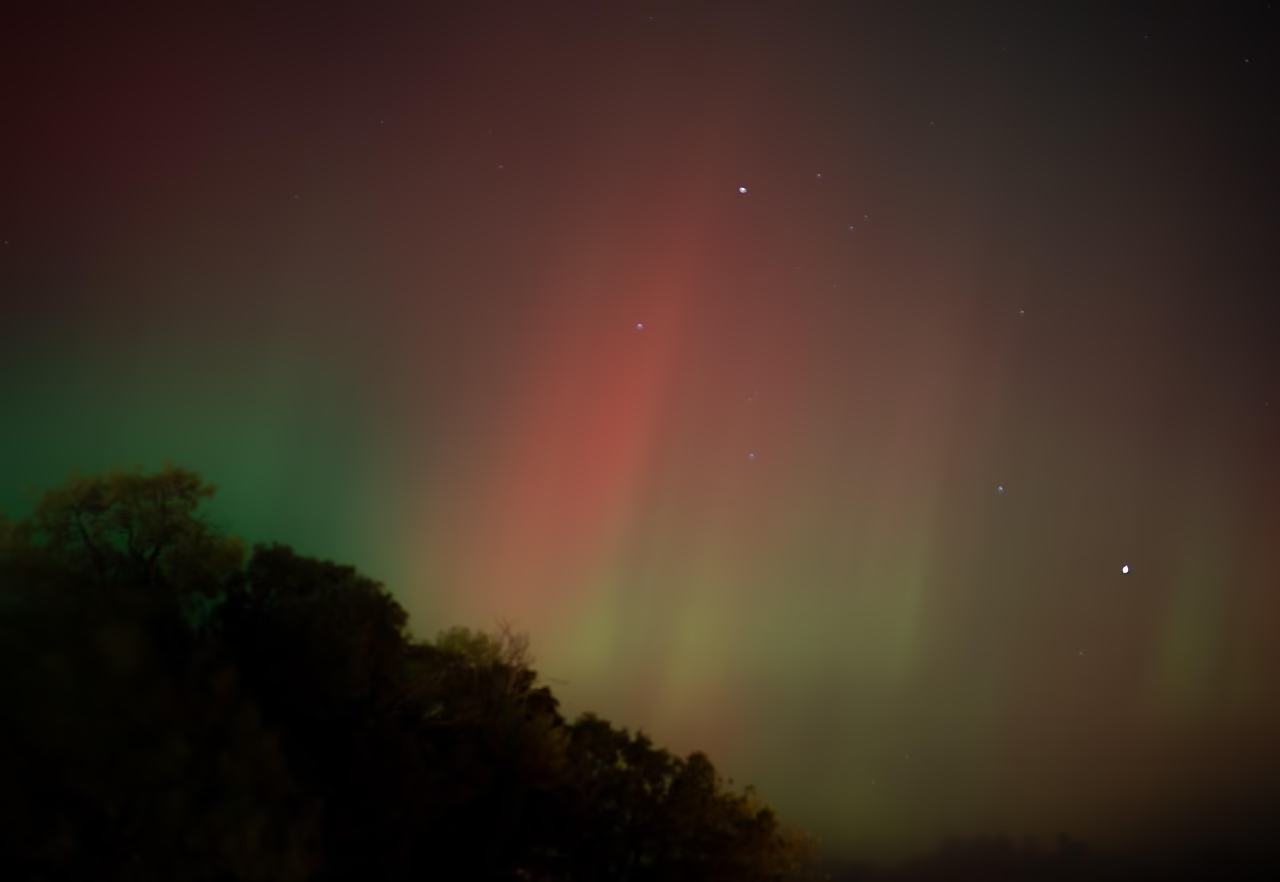
AI-powered aurora prediction represents a revolutionary advancement in space weather forecasting, fundamentally transforming our ability to anticipate and capture the magnificent displays of northern lights. Machine learning algorithms have achieved remarkable accuracy improvements, with some systems reaching 94% precision in detecting geomagnetic disturbances hours before they occur. These technological breakthroughs benefit aurora photographers, tourism operators, and citizen scientists worldwide, providing unprecedented opportunities to witness and study these celestial phenomena.
The integration of real-time satellite data, sophisticated algorithms, and global collaboration networks has created a new paradigm for space weather prediction. From NASA’s advanced neural networks to Finland’s deep learning systems that reduce false alarms by 42%, AI continues pushing the boundaries of what’s possible in aurora forecasting. As next-generation satellites and even more powerful machine learning techniques emerge, we can expect further improvements in accuracy, lead time, and accessibility.
The future holds exciting possibilities for aurora prediction technology, with transformer networks, physics-informed AI, and global standardization initiatives promising to make northern lights forecasting even more precise and widely available. Whether you’re a professional photographer planning the perfect shot or a curious traveler hoping to witness nature’s most spectacular light show, AI-powered prediction systems are opening new doors to experiencing the magic of the aurora borealis.
What aspects of AI aurora prediction interest you most? Are you planning to use these forecasting tools for your own northern lights adventures? Share your thoughts and experiences in the comments below—we’d love to hear about your aurora hunting success stories!
References
- NASA Heliophysics Division – Advanced space weather prediction systems research and development
- European Space Agency – Swarm mission magnetic field monitoring and analysis
- Finnish Meteorological Institute – Deep learning aurora prediction algorithm development
- NOAA Space Weather Prediction Center – Operational aurora forecasting services and data
- University of Alaska Geophysical Institute – Citizen science aurora observation networks
- National Center for Atmospheric Research – Next-generation AI algorithm development
- International Space Environment Service – Global space weather coordination initiatives