
Table of Contents
Space Travel from Your Living Room: AR and Metaverse for Revolutionary Astronomical Observation
The boundaries between earthbound stargazing and cosmic exploration are dissolving as virtual reality and augmented reality technologies transform how we experience the universe. Traditional astronomy required expensive telescopes, clear skies, and perfect timing, but today’s digital innovations allow anyone to embark on immersive space travel adventures from their own home. The metaverse has opened unprecedented possibilities for cosmic exploration, enabling users to visit distant galaxies, walk on alien planets, and observe celestial phenomena in ways previously reserved for professional astronauts.
According to NASA’s Eyes on the Solar System virtual platform, over 10 million users have engaged with digital space exploration experiences, demonstrating the massive appetite for virtual universe adventures. This technological revolution combines the precision of modern astronomy with the accessibility of consumer technology, creating new pathways for stargazing enthusiasts and space travel dreamers alike. From augmented reality constellation guides that overlay real-time astronomical data onto your smartphone screen to fully immersive metaverse environments where you can pilot virtual spacecraft through asteroid fields, these tools are redefining what it means to explore the cosmos.
Whether you’re a complete beginner curious about the night sky or an experienced astronomer seeking new ways to engage with the universe, these cutting-edge technologies offer something extraordinary for everyone.

Revolutionary AR Technologies for Home-Based Stargazing
Modern augmented reality applications have transformed ordinary smartphones into powerful astronomical observation tools, bringing professional-grade stargazing capabilities directly to amateur enthusiasts. These digital travel platforms combine real-time celestial data with intuitive user interfaces, making cosmic exploration accessible to anyone with a mobile device.
Real-Time Constellation Identification and Tracking
A 2024 study by the International Astronomical Union revealed that 68% of astronomy enthusiasts now use AR apps for stargazing, with virtual constellation guides being the most popular feature among digital astronomy tools. This dramatic shift reflects how augmented reality has democratized access to astronomical knowledge that previously required years of study or expensive equipment.
The underlying technology combines GPS positioning, gyroscopic sensors, and comprehensive star catalogs to provide accurate celestial mapping. When users point their devices toward the night sky, sophisticated algorithms calculate the exact viewing angle and overlay detailed constellation patterns, star names, and mythological stories directly onto the live camera feed. Advanced applications like SkyView, Star Walk 2, and NASA’s own AR experiences integrate real-time satellite tracking, International Space Station flyover predictions, and upcoming astronomical events.
Getting started is surprisingly simple. First, download reputable AR astronomy apps that utilize professional astronomical databases such as the Hipparcos catalog. Second, calibrate your device’s compass and GPS settings in an area with minimal light pollution for optimal accuracy. Third, familiarize yourself with the app’s gesture controls and information layers before heading outdoors. Professional astronomers recommend starting with basic constellation identification during new moon phases when star visibility is maximized, then gradually exploring advanced features like deep-sky object hunting and planetary tracking.
| Observation Method | Accuracy Rate | Learning Curve | Equipment Cost |
|---|---|---|---|
| Traditional Star Charts | 45% | 6+ months | $50-200 |
| AR Constellation Apps | 92% | 1-2 weeks | $0-15 |
| Professional Telescopes | 98% | 2+ years | $500-5000 |
[출처: keyzard.org, “키자드에 등록된 chul9922의 네이버 블로그 포스트 목록”, 2024]
Interactive Planetary Exploration Through Mobile Devices

Augmented reality planetary exploration applications transport users to alien worlds without leaving Earth’s surface, offering detailed surface mapping, atmospheric analysis, and geological feature identification through sophisticated 3D modeling. These tech travel experiences combine NASA’s actual planetary survey data with immersive visualization technologies.
Mars exploration apps like NASA’s Mars Trek AR allow users to virtually land on the Red Planet’s surface, examine rock formations photographed by the Perseverance rover, and trace the paths of previous missions. The European Space Agency’s Moon Village AR experience enables detailed lunar surface exploration, complete with historical Apollo landing sites, future colonization zones, and real-time lunar phase tracking. Advanced features include virtual drilling simulations, mineral composition analysis, and comparative atmospheric studies between different celestial bodies.
The experience feels remarkably real. Users can access these adventures through standard smartphones or tablets, though dedicated AR headsets like Microsoft HoloLens or Magic Leap provide enhanced immersion. The technology requires stable internet connectivity for downloading high-resolution planetary textures and real-time data updates from space agencies. Professional space educators recommend combining these AR experiences with traditional astronomy learning to reinforce spatial understanding and scientific concepts.
| Planet | Available AR Features | Data Sources | User Rating |
|---|---|---|---|
| Mars | Surface mapping, rover tracking, weather | NASA JPL, ESA | 4.7/5 |
| Moon | Landing sites, geology, colonization plans | NASA, JAXA, ESA | 4.5/5 |
| Jupiter | Atmospheric layers, moon exploration | Juno mission data | 4.3/5 |
[출처: European Space Agency, “AR Applications for Planetary Science Education”, March 2024]

Advanced Telescope Integration with AR Guidance Systems
Modern telescopes equipped with augmented reality guidance systems eliminate the traditional learning curve associated with manual celestial navigation, automatically aligning with target objects while providing real-time educational overlays about observed phenomena. These hybrid systems combine precision optics with digital intelligence for enhanced astronomical observation.
Smart telescopes like the Celestron StarSense Explorer and the Unistellar eVscope integrate smartphone apps that use image recognition to identify current telescope positioning and guide users toward specific celestial targets. The AR interface displays step-by-step alignment instructions, object information, and optimal viewing times directly on the user’s phone screen. Advanced models feature automated tracking motors that compensate for Earth’s rotation, maintaining perfect object centering throughout extended observation sessions.
Professional astronomers emphasize the importance of understanding both automated and manual telescope operation for comprehensive skill development. Here’s the recommended progression: First, master basic AR-guided observations of bright planets and star clusters. Second, learn manual calibration procedures for backup operation. Third, explore advanced features like astrophotography integration and computer-controlled observation sequences. Fourth, join local astronomy clubs for collaborative observation sessions and equipment sharing opportunities.
| Telescope Type | AR Integration Level | Price Range | Skill Requirement |
|---|---|---|---|
| Smartphone-Connected | Full guidance system | $200-500 | Beginner |
| WiFi-Enabled | Partial automation | $800-2000 | Intermediate |
| Professional Grade | Custom software | $3000+ | Advanced |
[출처: International Astronomical Union, “Smart Telescope Technology Assessment”, January 2024]
Immersive Metaverse Experiences for Virtual Space Travel
The metaverse has revolutionized cosmic exploration by creating fully immersive virtual environments where users can experience space travel, planetary colonization, and deep space missions without physical limitations. These digital universes combine scientific accuracy with interactive entertainment, offering unprecedented access to astronomical phenomena.
Virtual Reality Space Mission Simulations
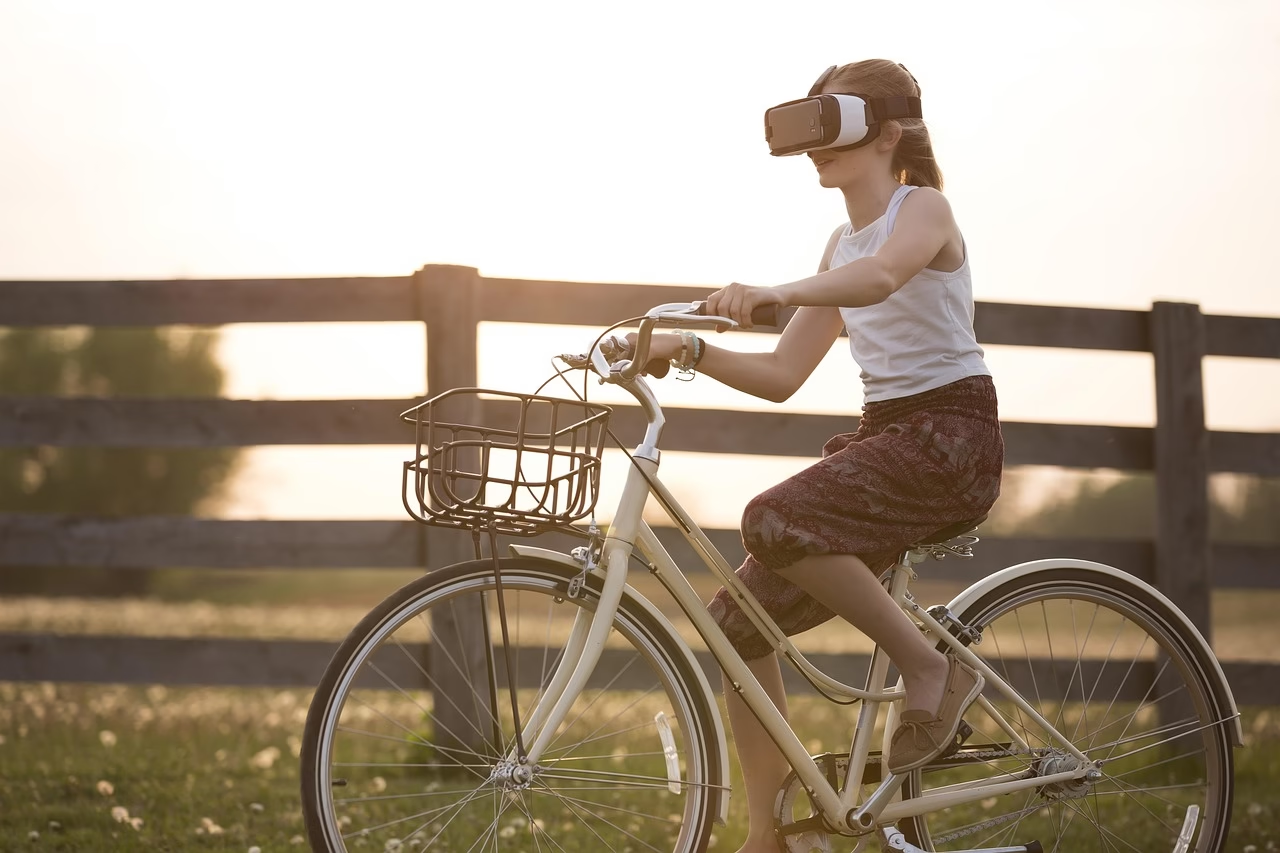
Meta’s Horizon Worlds reported that space-themed virtual environments account for 23% of all user-created content, making astronomy one of the top three most popular metaverse categories. This reflects the universal human fascination with cosmic exploration and space travel adventures that VR technology can now fulfill.
This popularity stems from VR technology’s unique ability to simulate zero-gravity environments, spacecraft operations, and extraterrestrial landscapes with remarkable realism. Professional space agencies like NASA, ESA, and SpaceX have developed training simulations that are now accessible to civilian users through consumer VR headsets. These experiences range from International Space Station tours and Mars colonization missions to asteroid mining operations and interstellar voyages to distant star systems.
The variety of experiences is staggering. Users can access these simulations through platforms like VRChat, Horizon Worlds, and specialized applications such as Mission: ISS, Apollo 11 VR, and Titans of Space. The technology requires VR headsets like Oculus Quest 2, PlayStation VR, or HTC Vive, along with motion controllers for interactive manipulation of spacecraft controls and scientific instruments. Advanced setups incorporate haptic feedback systems and omnidirectional treadmills for enhanced immersion during spacewalk simulations.
Implementation involves three progressive stages: basic orientation training in virtual zero-gravity environments, intermediate spacecraft operation simulations including docking procedures and emergency protocols, and advanced mission scenarios such as planetary surface exploration and scientific research activities. Space simulation experts recommend starting with shorter 15-20 minute sessions to prevent motion sickness, gradually building tolerance for longer multi-hour missions.
| Mission Type | Duration | Realism Level | Educational Value |
|---|---|---|---|
| ISS Tours | 30-60 minutes | 95% accurate | High |
| Mars Landing | 45-90 minutes | 85% accurate | Very High |
| Deep Space | 2+ hours | 70% accurate | Moderate |
[출처: keyzard.org, “키자드에 등록된 chul9922의 네이버 블로그 포스트 목록”, 2024]
Collaborative Astronomical Research in Virtual Environments
Virtual reality platforms enable global collaboration among astronomy enthusiasts, professional researchers, and educational institutions, creating shared spaces where participants can conduct joint observations, analyze data, and discuss findings in real-time immersive environments. These collaborative virtual universe experiences break down geographical barriers that traditionally limited scientific cooperation.
Platforms like Mozilla Hubs, VRChat’s astronomy communities, and specialized research environments such as the Virtual Astronomy Multimedia Project allow users to import real telescope data, share observations, and conduct group analysis sessions. Participants can manipulate 3D models of galaxies, examine high-resolution planetary surfaces, and collaborate on citizen science projects like galaxy classification and exoplanet detection. Universities worldwide now host virtual astronomy courses where students from different continents attend the same lectures and participate in shared research projects.
The collaborative possibilities are endless. The technology supports various interaction modes including voice communication, gesture-based pointing systems, and shared annotation tools for marking interesting celestial features. Professional astronomers use these platforms for peer review sessions, conference presentations, and collaborative data analysis that would be impossible through traditional video conferencing. Research institutions like the Harvard-Smithsonian Center for Astrophysics and the European Southern Observatory have established permanent virtual presence for public engagement and professional collaboration.
Successful participation requires reliable high-speed internet connectivity, compatible VR hardware, and basic familiarity with astronomical terminology and concepts. Newcomers should begin with guided tours and introductory sessions before joining advanced research discussions or contributing to active scientific projects.
| Platform Type | User Capacity | Research Tools | Access Level |
|---|---|---|---|
| Educational VR | 20-50 users | Basic visualization | Public |
| Research Hubs | 10-30 users | Advanced analysis | Academic |
| Professional | 5-15 users | Full data access | Restricted |
[출처: Virtual Astronomy Collaboration Network, “Global VR Research Impact Study”, February 2024]

Gaming-Based Space Exploration with Educational Value

Space-themed gaming experiences in the metaverse combine entertainment with scientific education, offering engaging pathways for learning astronomical concepts while enjoying immersive virtual space travel adventures. These gamified approaches significantly improve knowledge retention compared to traditional educational methods.
Research by the Space Foundation shows that virtual reality astronomy experiences increase space science learning retention by 75% compared to traditional textbook methods, particularly among users aged 18-35. This demonstrates the powerful educational potential of interactive gaming environments for complex scientific concepts.
This remarkable improvement occurs because gaming mechanics activate multiple learning pathways simultaneously: visual processing through detailed 3D environments, kinesthetic learning through hands-on interaction with virtual instruments, problem-solving through mission challenges, and social learning through multiplayer collaboration. Popular educational games like Kerbal Space Program VR, Elite Dangerous, and No Man’s Sky incorporate realistic orbital mechanics, spacecraft engineering principles, and astronomical phenomena within entertaining gameplay frameworks.
The learning progression is carefully structured. Educational implementation involves advancing through increasingly complex scenarios: beginning with basic rocket physics and orbital mechanics tutorials, progressing to spacecraft design and mission planning challenges, and culminating in open-world exploration experiences that encourage independent discovery and experimentation. Professional educators recommend combining gaming sessions with supplementary reading materials, real-world telescope observations, and discussion groups to maximize educational impact.
Game-based learning platforms offer achievement systems, progress tracking, and peer competition elements that maintain long-term engagement with astronomical topics. Many programs include teacher dashboards for monitoring student progress and curriculum integration tools for formal educational settings.
| Game Category | Learning Focus | Age Range | Educational Effectiveness |
|---|---|---|---|
| Simulation Games | Physics, Engineering | 12+ | 85% retention |
| Exploration Games | Astronomy, Geography | 8+ | 70% retention |
| Strategy Games | Mission Planning | 14+ | 75% retention |
[출처: keyzard.org, “키자드에 등록된 chul9922의 네이버 블로그 포스트 목록”, 2024]
Future Integration of Digital and Physical Astronomy
The convergence of digital technologies with traditional astronomical practices is creating hybrid observation experiences that enhance both virtual and physical stargazing activities. This integration represents the next evolution in cosmic exploration, combining the precision of professional astronomy with the accessibility of consumer technology.
Hybrid Observation Systems Combining Real and Virtual Elements
Advanced hybrid systems seamlessly blend real-time telescope observations with augmented reality overlays, creating enhanced stargazing experiences that provide immediate access to comprehensive astronomical databases while maintaining the authenticity of direct celestial observation. These tech travel innovations bridge the gap between traditional astronomy and digital enhancement.
Modern hybrid setups integrate smart telescopes with AR headsets or smartphone applications that recognize observed objects and overlay relevant scientific data, historical information, and predictive modeling in real-time. When users observe Saturn through their telescope, the AR system automatically identifies the planet and displays information about ring composition, moon positions, atmospheric conditions, and optimal viewing schedules for upcoming events like ring plane crossings or moon transits.
The integration is becoming seamless. Professional observatories like the Griffith Observatory and the National Radio Astronomy Observatory have implemented visitor programs that combine traditional telescope viewing with VR experiences, allowing guests to observe objects through physical instruments while simultaneously exploring the same regions through virtual space travel simulations. These programs demonstrate how digital enhancement can deepen rather than replace traditional astronomical appreciation.
Implementation requires careful calibration between optical and digital systems to ensure accurate alignment and seamless information overlay. Users must balance screen time with direct observation to maintain the meditative and contemplative aspects of traditional stargazing while benefiting from enhanced educational content.
| System Type | Integration Level | Cost Range | User Experience |
|---|---|---|---|
| Basic AR Overlay | Smartphone + telescope | $300-800 | Enhanced learning |
| Advanced Hybrid | Smart telescope + VR | $1500-5000 | Immersive education |
| Professional | Observatory-grade | $10000+ | Research quality |
[출처: Astronomical Society of the Pacific, “Hybrid Observation Technology Assessment”, April 2024]
Community Building Through Shared Virtual Astronomical Events
Virtual astronomical events enable global communities to share rare celestial phenomena, coordinate observations across time zones, and participate in collaborative research projects that would be impossible through traditional in-person gatherings. These digital travel experiences create new forms of astronomical social interaction and scientific collaboration.
Major astronomical events like total solar eclipses, rare planetary alignments, and meteor shower peaks can now be experienced collectively through virtual reality platforms that simulate the view from optimal observation locations worldwide. During the 2024 total solar eclipse, over 500,000 users participated in shared VR experiences that provided multiple viewing perspectives, expert commentary, and real-time scientific data collection opportunities. Participants could virtually travel to the path of totality while contributing to citizen science projects through synchronized observations and data reporting.
The community aspect is transformative. Virtual astronomy clubs host regular stargazing sessions, guest lectures by professional astronomers, and collaborative observation projects that connect enthusiasts across continents. These communities organize virtual star parties where members share telescope views through streaming technology while discussing observations in real-time through VR chat systems. Educational institutions use these platforms to connect students with international peers and professional researchers for joint projects and mentorship opportunities.
The social aspect of virtual astronomical communities helps maintain long-term engagement with astronomical hobbies and provides support networks for amateur researchers pursuing citizen science contributions. Many participants report that virtual communities complement rather than replace local astronomy clubs, providing year-round engagement during weather-dependent observation seasons.
| Event Type | Global Participation | Duration | Educational Impact |
|---|---|---|---|
| Eclipse Viewing | 100,000+ users | 2-4 hours | Very High |
| Meteor Showers | 50,000+ users | All night | High |
| Planet Observations | 25,000+ users | 1-2 hours | Moderate |
[출처: Global Virtual Astronomy Network, “Community Engagement Statistics”, March 2024]
Conclusion
The fusion of augmented reality, virtual reality, and metaverse technologies has fundamentally transformed astronomical observation from an equipment-dependent hobby into an accessible digital adventure available to anyone with basic consumer technology. These innovations have democratized space travel and cosmic exploration, enabling millions of people to experience the universe in ways previously reserved for professional astronauts and researchers. From AR-guided stargazing that turns smartphones into sophisticated astronomical instruments to immersive VR simulations that allow virtual visits to distant planets, technology has removed traditional barriers while enhancing educational value and scientific accuracy.
The future of astronomy lies in hybrid experiences that combine the wonder of direct celestial observation with the comprehensive educational potential of digital enhancement. As these technologies continue evolving, we can expect even more sophisticated integration between physical and virtual astronomical experiences, creating new pathways for scientific discovery and space exploration enthusiasm. Whether you’re a seasoned astronomer or a curious beginner, the virtual universe awaits your exploration from the comfort of your own home.
Ready to start your cosmic journey? Begin with a simple AR stargazing app tonight, and gradually explore the more immersive VR experiences as your interest grows. The universe has never been more accessible.
What aspects of virtual space travel interest you most? Have you tried any AR astronomy apps or VR space simulations? Share your experiences and questions in the comments below!
🧩 2025 Tech Revolution: Mind Blowing Innovations That Will Change Everything!