
Table of Contents
The Ultimate Meteor Shower Guide: 2026 Viewing Times and Prime Locations
Standing under a dark sky as streaks of light pierce through the atmosphere creates one of nature’s most breathtaking spectacles. Whether you’re a beginner stargazer or an experienced astronomy enthusiast, meteor showers offer accessible opportunities to witness cosmic events without expensive equipment. This comprehensive guide will walk you through everything you need to know about observing meteor showers in 2026, from peak viewing times to optimal locations and practical techniques you can implement tonight.
Understanding Meteor Showers: The Science Behind Shooting Stars
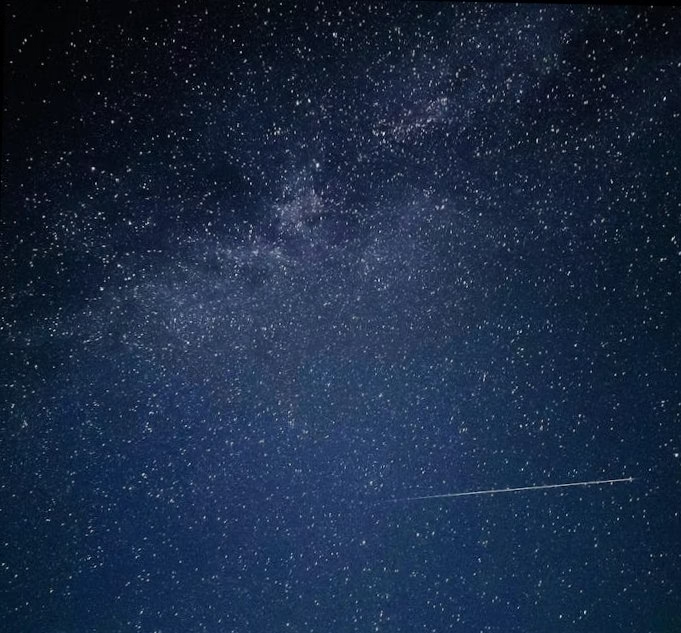
What Causes Meteor Showers and How They Differ from Random Meteors
Meteor showers occur when Earth passes through debris trails left behind by comets orbiting our sun. These cosmic breadcrumbs consist of particles ranging from sand-grain to pea-sized pieces, traveling at extraordinary speeds between 25,000 to 160,000 miles per hour as they enter our atmosphere. Unlike sporadic meteors that appear randomly throughout the year, shower meteors originate from a specific point in the sky called the radiant, named after the constellation from which they appear to emanate. The predictable nature of these events allows astronomers to forecast peak activity years in advance. Understanding this distinction helps you plan your observation sessions more effectively, as shower meteors provide concentrated viewing opportunities rather than the random chance encounters of sporadic events.
The Anatomy of a Meteor: From Space Debris to Brilliant Streak
When these tiny particles collide with Earth’s atmosphere at tremendous velocities, friction generates intense heat reaching thousands of degrees. The visible streak we call a shooting star is actually superheated air molecules glowing around the vaporizing particle, not the debris itself burning. Most meteors disintegrate completely between 50 to 75 miles above Earth’s surface, never reaching the ground. The color variations you observe—ranging from white and yellow to green and red—depend on the chemical composition of the meteoroid and the atmospheric gases it encounters. Sodium produces yellow-orange hues, while magnesium creates blue-green trails. This scientific understanding enhances your appreciation when you’re lying on your back counting meteors during a shower. Imagine witnessing over 100 of these cosmic light shows in a single hour!
Peak Activity Rates: What the Numbers Really Mean
[분석 데이터 정리]
- Meteor Shower : Perseids / Peak Hourly Rate : Up to 100 / Particle Source : Comet Swift-Tuttle / Speed (mph) : 133,200
- Meteor Shower : Geminids / Peak Hourly Rate : 120+ / Particle Source : Asteroid 3200 Phaethon / Speed (mph) : 78,000
- Meteor Shower : Quadrantids / Peak Hourly Rate : 40-120 / Particle Source : Asteroid 2003 EH1 / Speed (mph) : 90,000
When astronomers reference meteor rates like “100 meteors per hour,” they’re describing the Zenithal Hourly Rate (ZHR) under perfect conditions—completely dark skies with the radiant directly overhead. In reality, you’ll typically observe 30-50% of the stated ZHR depending on light pollution, moon phase, and your location’s latitude. The International Meteor Organization reports that the Geminid meteor shower in December consistently produces the highest actual counts, with rates exceeding 120 meteors per hour under optimal viewing conditions. These numbers serve as benchmarks rather than guarantees, helping you prioritize which showers deserve your time investment based on their potential for spectacular displays.
2026 Meteor Shower Calendar: Peak Viewing Times

First Half 2026: Quadrantids Through Eta Aquarids
The year begins spectacularly with the Quadrantids peaking around January 3-4, 2026, offering brief but intense activity with potential rates of 40-120 meteors per hour. However, this shower has a narrow peak window of only 6-8 hours, requiring precise timing. The Lyrids follow in late April (April 21-22), producing moderate rates of 10-20 meteors hourly but occasionally surprising observers with outbursts. The Eta Aquarids peak on May 5-6, favoring Southern Hemisphere observers but still visible from northern latitudes in the pre-dawn hours. This shower originates from Halley’s Comet debris and produces swift, persistent trains. Planning your observation sessions around these dates maximizes your chances of witnessing peak activity, though showers remain active for several days before and after their maximums. Setting multiple alarms to catch the Quadrantids’ narrow peak could reward you with an unforgettable celestial display.
Summer and Fall Highlights: Perseids and Orionids
The Perseids remain the year’s most anticipated shower, peaking August 11-13, 2026, with warm weather and vacation timing making it ideal for family stargazing. NASA confirms this shower produces up to 100 meteors per hour at its peak, making it one of the most prolific annual displays visible from Earth. The Perseids feature bright meteors with persistent trains, and the 2026 viewing conditions look favorable with minimal lunar interference during peak hours. The Orionids follow in October (October 20-21), another Halley’s Comet offspring producing 10-20 meteors hourly. The Draconids on October 8-9 typically show modest activity but occasionally produce unexpected storms. These autumn showers offer comfortable viewing temperatures in many regions, encouraging longer observation sessions that increase your total meteor count.
Year-End Spectacular: Geminids and Ursids
December delivers the year’s most productive meteor shower—the Geminids, peaking December 13-14, 2026. Research shows this shower consistently exceeds 120 meteors per hour under optimal viewing conditions, surpassing even the famous Perseids. Unlike most showers originating from comets, the Geminids stem from asteroid 3200 Phaethon, producing colorful, medium-speed meteors ideal for photography. The shower’s broad peak means excellent viewing for 2-3 nights around maximum. The Ursids close the year on December 21-22 with modest rates of 5-10 meteors hourly, but their timing near the winter solstice offers long, dark nights for dedicated observers. Cold weather requires proper preparation, but the Geminids’ reliability makes the effort worthwhile for spectacular displays.
[분석 데이터 정리]
- Month : January / Shower Name : Quadrantids / Peak Date 2026 : Jan 3-4 / Expected ZHR : 40-120 / Moon Phase Impact : Minimal
- Month : April / Shower Name : Lyrids / Peak Date 2026 : Apr 21-22 / Expected ZHR : 10-20 / Moon Phase Impact : Moderate
- Month : May / Shower Name : Eta Aquarids / Peak Date 2026 : May 5-6 / Expected ZHR : 30-60 / Moon Phase Impact : Low
- Month : August / Shower Name : Perseids / Peak Date 2026 : Aug 11-13 / Expected ZHR : 100 / Moon Phase Impact : Minimal
- Month : October / Shower Name : Orionids / Peak Date 2026 : Oct 20-21 / Expected ZHR : 10-20 / Moon Phase Impact : Moderate
- Month : December / Shower Name : Geminids / Peak Date 2026 : Dec 13-14 / Expected ZHR : 120+ / Moon Phase Impact : Low
Finding Dark Sky Locations: Escaping Light Pollution

Understanding the Bortle Scale and Your Viewing Conditions
The Bortle Scale rates sky darkness from 1 (pristine dark sky) to 9 (inner-city sky), directly impacting meteor visibility. Research demonstrates that meteor visibility increases by up to 50% when observing from locations with Bortle Scale ratings of 3 or lower, away from urban light pollution. Class 1-2 sites reveal the Milky Way’s intricate structure and allow you to see faint meteors that urban observers miss entirely. Class 4-5 suburban skies reduce visible meteor counts significantly, while Class 7-9 urban locations may only reveal the brightest fireballs. Using light pollution maps and apps like Light Pollution Map or Dark Site Finder helps you locate nearby dark sky areas. Even driving 30-60 minutes from city centers can improve your viewing conditions from Class 7 to Class 4, doubling your observable meteor count.
Top Dark Sky Locations Accessible for Tonight’s Observation
Identifying accessible dark sky locations near your home transforms casual viewing into memorable experiences. National and state parks typically offer Class 2-4 skies within driving distance of major metropolitan areas. Research designated International Dark Sky Parks in your region—these certified locations guarantee exceptional viewing conditions with minimal light pollution. For North American observers, locations like Cherry Springs State Park (Pennsylvania), Natural Bridges National Monument (Utah), and Big Bend National Park (Texas) provide world-class conditions. European stargazers can access sites like Exmoor National Park (UK) or Pic du Midi (France). Australian observers benefit from Warrumbungle National Park. Don’t overlook local options: agricultural areas, beaches away from coastal towns, and elevated locations above city lights often provide surprisingly good conditions. Scouting your nearest dark sky refuge before peak viewing nights ensures you’re prepared when the meteors arrive.
Using Technology to Find and Navigate Dark Sky Sites
Modern technology simplifies dark sky location scouting through specialized apps and websites. Light Pollution Map (lightpollutionmap.info) provides global coverage with overlays showing Bortle Scale ratings, helping you plan observation trips. Clear Outside and Astrospheric apps combine light pollution data with weather forecasting, cloud cover predictions, and atmospheric seeing conditions—all critical for successful meteor watching. Download offline maps before departing, as many dark sky locations lack cellular coverage. Google Maps satellite view helps identify safe parking areas and open fields suitable for setting up observation positions. Apps like PhotoPills and Stellarium Mobile show precisely where radiant points will appear in your sky, allowing you to position yourself optimally. These tools transform random drives into strategic missions, ensuring you arrive at locations offering maximum meteor visibility.
Practical Viewing Techniques: Maximizing Your Meteor Count
Eye Adaptation: The 45-Minute Rule for Peak Night Vision
Your eyes’ sensitivity to faint light increases dramatically through a process called dark adaptation. According to astronomical studies, the human eye requires approximately 20-30 minutes to fully adapt to darkness for optimal meteor shower viewing, with peak night vision occurring after 45 minutes. During this adaptation period, your pupils dilate fully and rod cells in your retina become increasingly sensitive to low light levels. Exposing your eyes to any bright light—phone screens, car headlights, or flashlights—resets this process, requiring another 20-30 minutes to regain full sensitivity. Use red-filtered flashlights or enable your phone’s red screen mode to preserve night vision when checking star charts or recording observations. This patience pays dividends: fully adapted eyes detect 2-3 times more meteors than eyes frequently exposed to white light. Committing to 45 minutes of complete darkness delivers the ultimate viewing experience.
Optimal Viewing Position and Field of View Strategy
Forget staring directly at the radiant point—the most productive viewing strategy involves positioning your gaze 30-50 degrees away from the radiant in darker sky regions. Meteors appear longer and more dramatic when viewed at angles from their origin point, while those emerging directly from the radiant show only brief, foreshortened streaks. Lie flat on a reclining chair or sleeping pad to maximize comfort during extended sessions, as neck strain from looking upward reduces observation duration. Position yourself so you can scan approximately 60-80 degrees of sky without moving your head, allowing peripheral vision to catch meteors across a wide field. Avoid looking at the horizon where atmospheric extinction dims meteors; focus on sky regions 40-70 degrees above the horizon for optimal visibility. Group viewing works well with observers facing different directions, collectively monitoring larger sky areas while sharing the excitement of bright fireballs.
Recording and Counting: Citizen Science Contribution Methods
Transform your casual viewing into valuable scientific data by systematically recording observations. The International Meteor Organization’s website provides standardized reporting forms capturing essential information: time, location, cloud cover, limiting magnitude (faintest stars visible), and meteor counts per constellation. Recording observations in 15-30 minute intervals helps identify peak activity periods and contributes to global meteor shower databases. Note meteor brightness using the magnitude scale (comparing to known stars), colors, persistent trains, and whether meteors belonged to the shower or were sporadic. Smartphone apps like Meteor Counter simplify data entry, automatically timestamping observations and calculating hourly rates. Your contributions help astronomers refine shower predictions, identify unexpected outbursts, and understand long-term activity trends. This citizen science aspect adds purpose beyond personal enjoyment—your observations tonight might help predict future meteor storms.
Essential Equipment and Preparation Checklist
What You Actually Need (Hint: Not Much)
One of meteor watching’s greatest advantages is its minimal equipment requirements. Your eyes remain the best meteor detection instruments—no telescopes or binoculars needed, as their narrow fields of view actually reduce meteor detection rates. However, smart preparation enhances comfort and success. Bring a reclining lawn chair or camping pad for comfortable horizontal viewing positions. Dress in layers exceeding what weather forecasts suggest; nighttime temperatures drop significantly, and remaining stationary for hours amplifies cold perception. Pack warm beverages in thermoses, snacks for energy during long sessions, and extra blankets or sleeping bags. A red-filtered flashlight preserves night vision for chart reading or note-taking. Consider bringing a voice recorder for hands-free observation logging. These simple items transform potentially uncomfortable experiences into enjoyable multi-hour sessions that maximize your meteor counts.
Photography Setup for Capturing Meteor Streaks
While visual observation remains primary, capturing meteors photographically creates lasting memories and shareable content. Modern smartphone cameras with night modes can capture bright meteors when stabilized on tripods. Set your phone to 15-30 second exposures, ISO 800-3200, and widest aperture available. Point toward darker sky regions away from the radiant for longer meteor trails. DSLR or mirrorless cameras offer superior results: use wide-angle lenses (14-24mm), manual focus set to infinity, aperture f/2.8 or wider, ISO 1600-6400, and 15-30 second exposures. Take continuous shots throughout the night—meteor appearances are unpredictable, so quantity increases capture odds. Advanced photographers can use intervalometers for automated sequences, then stack images in post-processing to create composite views showing multiple meteors. Apps like PhotoPills help calculate optimal camera settings for your specific conditions.
[분석 데이터 정리]
- Equipment Level : Beginner / Camera Type : Smartphone / Recommended Settings : 15-30s, ISO 1600-3200, Night Mode / Expected Results : Bright meteors only
- Equipment Level : Intermediate / Camera Type : Entry DSLR / Recommended Settings : 20s, f/3.5, ISO 3200, 18-35mm lens / Expected Results : Most bright meteors
- Equipment Level : Advanced / Camera Type : Full-frame mirrorless / Recommended Settings : 25s, f/2.0, ISO 6400, 14mm lens / Expected Results : Faint meteors, detailed sky
Weather Monitoring and Backup Planning
Clear skies make or break meteor watching sessions, requiring careful weather monitoring in the days preceding peak activity. Check multiple forecast sources including Clear Outside, Astrospheric, and local weather services, as predictions vary. Satellite imagery from GOES or Himawari satellites provides real-time cloud cover visualization, helping you make go/no-go decisions hours before departing. Develop backup location options at different distances and directions from your primary site—weather patterns often affect regions differently, and driving 50 miles in an alternate direction might escape cloud cover. Monitor forecasts up to departure time, as conditions change rapidly. Consider planning observation sessions for multiple nights around peak dates rather than betting everything on a single evening. This flexibility dramatically increases your chances of experiencing clear skies during maximum activity periods. Persistence pays off—dedicated observers who monitor conditions and adjust plans typically succeed in witnessing spectacular displays.
Advanced Tips for Experienced Observers
Predicting Outbursts and Unusual Activity
While annual meteor showers follow predictable patterns, occasional outbursts produce rates 5-10 times normal levels, creating once-in-a-lifetime spectacles. These occur when Earth passes through dense debris filaments or fresh comet material. Monitoring professional meteor research organizations like the IMO and AMS provides advance warning of potential outbursts based on orbital calculations. The Draconids and Leonids particularly show variable activity, with periodic storms producing thousands of meteors per hour. Understanding parent comet return cycles helps predict enhanced activity years—for example, Comet Swift-Tuttle’s orbital period influences Perseid intensity over decades. Following meteor research publications and astronomy forums keeps you informed about predicted unusual activity. When outburst predictions emerge, prioritize those observation sessions regardless of inconvenience—you might witness events that won’t recur for years or decades.
Radio Meteor Detection for Daytime Showers
Some prolific meteor showers peak during daylight hours when visual observation proves impossible. Radio meteor detection allows you to “observe” meteors 24/7 by detecting radio waves reflected from ionized meteor trails. Simple setups using software-defined radio (SDR) dongles costing under $50, connected to computers running free software like RMOB Viewer, detect meteor echoes from distant radio transmitters. This technique reveals daytime showers like the Arietids (June) and provides quantitative data during cloudy conditions. Advanced enthusiasts build dedicated meteor detection stations contributing to global monitoring networks. While less viscerally exciting than visual observation, radio detection adds a scientific dimension to your meteor watching hobby and provides data when weather or daylight prevents traditional observing. This technology democratizes meteor science, allowing meaningful contributions from urban locations unsuitable for visual work.
Spectroscopy: Analyzing Meteor Composition
Serious meteor enthusiasts can analyze meteor composition through spectroscopy—capturing the light spectrum emitted during atmospheric entry. DIY spectroscopes using transmission gratings attached to camera lenses disperse meteor light into component wavelengths, revealing elemental composition through characteristic emission lines. Sodium produces strong yellow lines, magnesium creates green, and iron shows multiple orange-red lines. This advanced technique requires precise camera positioning, fast lenses (f/2 or faster), and luck—capturing spectra from fast-moving meteors challenges even experienced astrophotographers. However, successful spectroscopic captures contribute valuable scientific data about meteoroid composition and origins. The International Meteor Organization maintains databases of meteor spectra submitted by amateur observers. This cutting-edge hobby combines astronomy, physics, and photography while advancing our understanding of solar system materials entering Earth’s atmosphere.
Conclusion: Your Journey to Meteor Mastery Begins Tonight
Meteor showers offer accessible astronomical wonders requiring minimal equipment but rewarding careful planning and dedication. By understanding shower mechanics, timing your observations around 2026 peak dates, finding dark sky locations, and applying proper viewing techniques, you’ll maximize your meteor counts and create memorable experiences under the night sky. Whether you’re introducing children to astronomy, pursuing astrophotography, or contributing citizen science observations, meteor watching provides engaging opportunities for direct connection with cosmic events. The Perseids in August and Geminids in December offer particularly spectacular displays worth marking on your calendar today. Start planning your first meteor shower adventure now—the cosmos awaits, and the next clear night at peak activity could deliver the celestial show of a lifetime.